
Learning Systems That Learn — Visualizing Design Intelligence for Every Course
-
This dashboard is designed to act as a course design report and to connect course design to the context insights submitted in the course intake form. You will find downloadable course learning materials at the end of this dashboard.
The audience for this dashboard includes facilitators, decision-makers, instructional designers, SME. The dashboard is not intended to be learner-facing.
modulr.blueprint dashboard™
-
This section of the dashboard provides a high-level view of your course. The content in this section is shaped by constraints you identified when completing the learning needs intake form.
Course
Building Awareness and Commitment to a Unified Quality Management System
Organization
Sample
SCOPE
Enterprise-wide QMS awareness and early adoption judgment for a multi-acquisition organization operating across laboratories, engineering, and corporate services.
Purpose
Establish shared understanding, decision quality, and behavioral commitment during QMS platform transition.
DESIGN RATIONALE — WHAT DID WE PRIORITIZE AND WHY
-
Based on the responses provided in your learning needs course intake, the Modulr.Blueprint system prioritized content and instructional design choices around your operational environment and constraints.
content priority
Enterprise QMS rationale, documentation hierarchy, CAPA, and early adoption behaviors.
Why it matters: These elements directly address risk created by parallel systems and inconsistent execution identified in the Intake.
instructional priority
Judgment-centered decision-making under real operational constraints.
Why it matters: Learners must choose correctly under time pressure, not recall procedures.
design constraints
Live delivery, limited time (1–1.5 hours), mixed technical audience.
Why it matters: Required a cognitively efficient, discussion-driven design without procedural depth.
design drivers
-
The behavioral, operational, and technical design drivers in this section extend naturally from the context challenges identified in the course intake. They allow you to see how the course addresses core performance challenges identified in the intake form.
Acquisition-driven fragmentation across legacy QMSs [Operational]
Time pressure, bandwidth limits, and delivery commitments during integration [Operational]
Cultural tension between acquired companies and corporate governance [Behavioral]
Risk of parallel systems causing invalid tests, rework, and customer impact [Technical]
Need for visible behavior change to make the new QMS “stick” [Behavioral]
design overview
-
This section highlights the audience, content themes, and learning objectives, all of which are informed by the course intake form.
Audience
Primary audience:
Technical employees (lab technicians, test engineers)
Lab supervisors
Secondary (contextual):
Corporate services (Quality, IT, HR, Finance, Procurement, Sales, Legal)
Learners operate in lab, engineering, and customer-facing environments with regulatory, customer, and delivery pressure.
content
Why move to a single unified QMS
Risks and costs of parallel legacy systems
What are our internal quality documentation hierarchy and governing documents
Continuous improvement and CAPA as shared responsibilities
Cultural commitment and adoption behaviors in the first 90 days
Procedural and regulatory depth is intentionally deferred to follow-on training.
objectives
Learners will:
Evaluate enterprise risk created by continued legacy practices
Decide how to prioritize full QMS adoption under constraints
Distinguish correct use of the internal documentation hierarchy
Judge when to use formal CAPA versus informal local fixes
Commit to visible adoption behaviors during early deployment
How is it Designed
-
This section looks closely at the instructional design frameworks used to shape the course. It presents insights about how modules are built and how this custom course is different from generic courses.
Module Highlights
-
The module highlights component features key points from each module.
This section also illuminates where Context-Drive Instruction™ (CDI) overlaps with challenges identified by you in the course intake form.
CDI are the concepts used to analyze the challenges that impact judgment in operational context. CDI will be defined and fully explored later in the dashboard.
Course-level framework balance:
Strong emphasis on Modulr.Context, Andragogy, Bloom (Evaluate/Judge/Decide), and Cognitive Load efficiency; moderate use of Merrill and Gagné for structure without procedural overload.
Module-level framework narrative:
All four modules apply consistent judgment framing, with increasing behavioral ownership from rationale (Module 1) to commitment (Module 4).
Design Emphasis:
How This Course Differs from Generic Training.
Focuses on decision quality and behavior under pressure, not policy walkthroughs.
Module 1: Enterprise risk of parallel QMSs; legacy vs unified decisions
Module 2: Documentation hierarchy as a control mechanism
Module 3: CAPA as organization-wide learning, not local fixes
Module 4: Culture, commitment, and first-90-day adoption behaviors
Design Insights — What this tells us
-
This section begins to look deeper into the course design. It explores how judgment-centric design is coordinating with learning principles to produce a custom course built around your operational context.
Integration risk is primarily behavioral, not informational.
Judgment-based discussion is more effective than procedural training at this stage.
Early visible adoption behaviors are critical to eliminating legacy systems.
Live facilitation quality materially affects learning impact.
Context-Drive Instruction™ Insights
-
This section on Context-Drive Instruction™ (CDI) begins to make the connections between the course and the intake much more explicit. CDI is a proprietary term that emphasizes operational context in learning design.
CDI assumes that adult learners are knowledgeable about their field and that learning design should center on the parts of performance that cause judgment and decision-making to breakdown.
-
This selection of accordion items lists the CDI terminology. It shows you the relationship between context and judgment issues identified in the intake as core learning needs and how they appear in the learning materials.
A Context-Driven Instruction (CDI) analysis does not invent an organization’s reality — it surfaces the reality already embedded in the training request.
The course encodes an operational environment where rapid acquisition-driven growth has outpaced process integration, resulting in parallel quality systems.
Learners operate under immediate delivery expectations while being asked to change core execution behaviors.
Quality decisions are framed as enterprise-risk multipliers rather than local optimizations.
Cultural integration and visible commitment are treated as operational variables, not soft add-ons.
These reflections represent the operational pressures encoded in the course and intake materials and are limited strictly to the course layer.
-
Intake: “Constraints are definitely bandwidth and time.” / “Where will learners apply this skill in the first 90 days after training?”
Script: “Limited time and pressure to maintain delivery,” “time is tight,” “already behind schedule.”
Assessment: Scenarios assume immediate execution under delivery pressure.
-
Intake: “35 quality management systems that must be integrated into one common approach.”
Script: “Multiple versions exist,” “conflicts with familiar legacy practices,” “unclear which document governs the work.”
Assessment: Questions referencing parallel systems and conflicting documentation.
-
Intake: “The organization acquired over 35 companies… continued to operate independently.”
Script: “More than 35 legacy QMSs,” “operating parallel systems introduces risk.”
Assessment: Items on legacy QMS use vs unified system.
-
Intake: “Tension between a smaller family owned business and corporate entity cultures.” / Independent QA managers integrating into corporate QA.
Script: “Cultural tension,” “peers debate,” “integration is live.”
Assessment: Items on commitment, adoption behavior, and signaling resistance.
-
Intake: Multiple concrete examples (parallel execution, invalid tests, rework, customer impact).
Script: Recurrent lab, document, CAPA, and adoption scenarios.
Assessment: 20 scenario-based items across four modules.
-
Intake: “Pulling resources from the labs has consequences.” / Uneven readiness across locations.
Script: “Bandwidth constraints,” “learning curve,” reliance on corporate systems.
Assessment: Scenarios assume constrained access to time and support.
-
Intake: “Lack of commitment,” “pressure,” “impacting customer satisfaction.”
Script: “Pressure is real,” “short-term discomfort,” “visible behavior.”
Assessment: Items probing hesitation, delay, and resistance.
-
These two tables show how the CDI elements are weighted at the course-level and at the module level.
This is not a ranking system. A ‘3’ indicates that more emphasis is on that element. A ‘1’ indicates less emphasis. These are emphasis markers, not value markers.
These tables reveal how the context captured in the intake is distributed in the learning design.
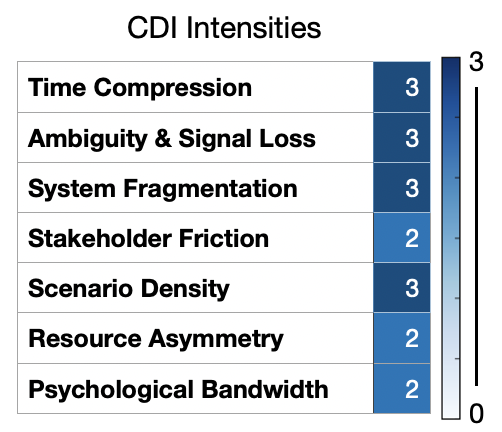
This course-wide graphic highlights which contextual forces exert the strongest influence on real-world judgment. Time pressure, fragmentation, ambiguity, and dense scenario exposure function as core drivers shaping learner decisions; stakeholder, resource, and psychological constraints are explicit but secondary.
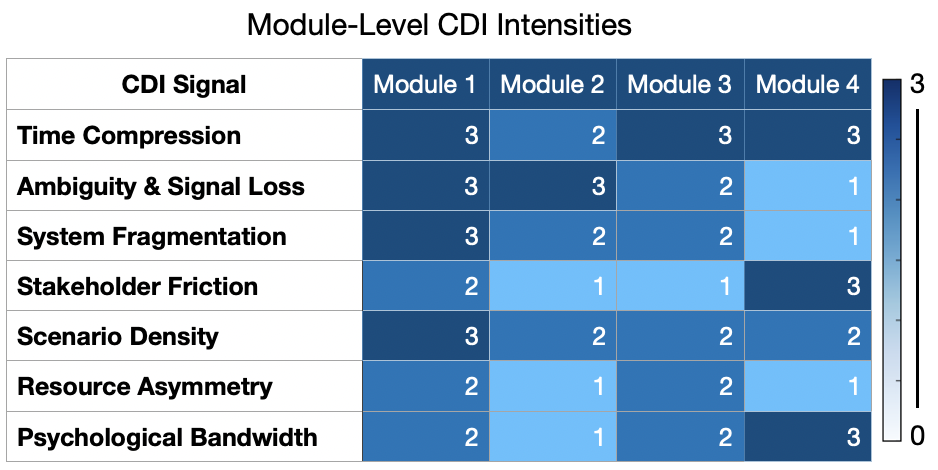
This graphic illustrates how contextual pressures vary across modules, concentrating early on structural risk and later on cultural and commitment dynamics.
-
This section shows the way operational pressures overlap. They inform the way the script, judgment prompts, and assessments explore the complex operational environment identified in the intake form.
Constraint Interactions
Time Compression × System Fragmentation — Delivery pressure amplifies reliance on legacy systems, increasing parallel execution risk (Intake example of opening projects in new systems but executing work in old ones).
Ambiguity & Signal Loss × Scenario Density — Frequent, varied scenarios with unclear governing signals increase decision fatigue around documentation and process selection.
Stakeholder Friction × Psychological Bandwidth — Cultural tension combined with visible adoption expectations heightens emotional load during early integration.
Resource Asymmetry × Time Compression — Limited lab resources and training time constrain proper adoption of new tools, increasing shortcut behavior.
This view surfaces where multiple contextual pressures converge, creating compounded judgment difficulty rather than isolated challenges.
-
This course teaches resilience and trains learners to maintain optimal judgment performance. This section explores the conditions where judgment is most likely to be compromised, and it shows were these three zones of potential fracture are taken up in the course materials.
Judgment instability zones
Parallel Execution Zone: When new systems are available but legacy methods feel faster, creating high risk of inconsistent data and invalid results.
Documentation Conflict Zone: When multiple documents exist and time pressure pushes learners toward familiarity over hierarchy.
Early Adoption Visibility Zone: First-90-day behaviors where hesitation or quiet adoption sends unintended cultural signals.
These zones highlight moments where judgment becomes less stable due to overlapping time, ambiguity, and cultural pressures that encourage short-term coping decisions.
Together, these CDI patterns outline how contextual forces shape decision-making across the learning experience. The combined view highlights how time pressure, fragmentation, and ambiguity concentrate early, while cultural commitment and psychological load dominate later, defining how learners navigate competing demands within the environment represented by this course.
Downloads
next steps
Review → Approve → Build → Integrate into LMS.
Option: Request Dashboard Walkthrough for SME artifact alignment.
Metadata and Footer
Generated By: Modulr.Bluepring
Based On: Modulr.Context and Modulr.Bluepring Behavioral Rules
Compliance Check: ✔ Tier 1 Behavioral Rules
Blueprint Version: 1.0